Why 2026 Is the “Make or Break” Year for Sustainable Aviation Fuel
Aviation accounts for roughly 2.5% of global CO₂ emissions, but its climate impact, when you factor in contrails, nitrogen oxides, and high-altitude warming effects, may be two to four times larger. For years, the industry’s answer to that problem has been a single, three-letter acronym: SAF. Sustainable Aviation Fuel has been hailed as the most viable, near-term pathway to decarbonizing flight, capable of reducing lifecycle greenhouse gas emissions by up to 94% compared to fossil jet fuel depending on the feedstock and production process.
But in 2026, the rubber is finally meeting the runway and the turbulence is real.
This is the year that mandates become enforceable, funding decisions become irreversible, and the gap between ambition and reality becomes impossible to ignore. Whether SAF becomes the backbone of green aviation or stalls out as an expensive, under-scaled experiment will largely be determined by what happens in 2026. Here’s why.
What is Sustainable Aviation Fuel and Why Does It Matter?
Before diving into the politics and economics, it’s worth grounding the conversation. SAF is a drop-in fuel alternative to conventional jet kerosene. It can be blended with traditional jet fuel and used in existing aircraft engines and fueling infrastructure without major modifications — a critical advantage over more disruptive alternatives like hydrogen or electric propulsion, which require entirely new aircraft designs and airport systems.
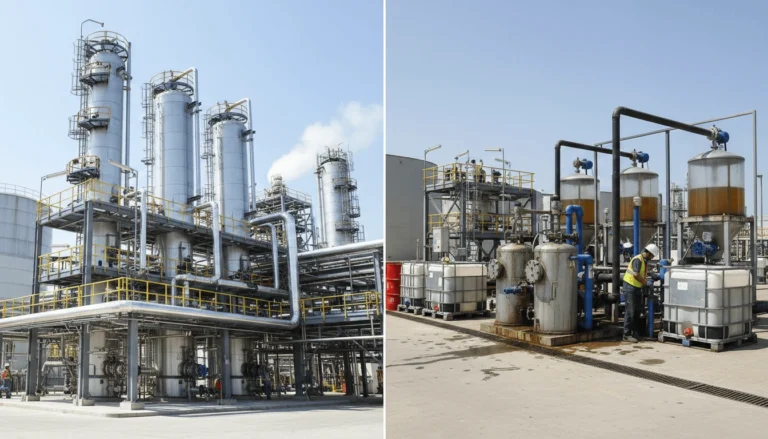
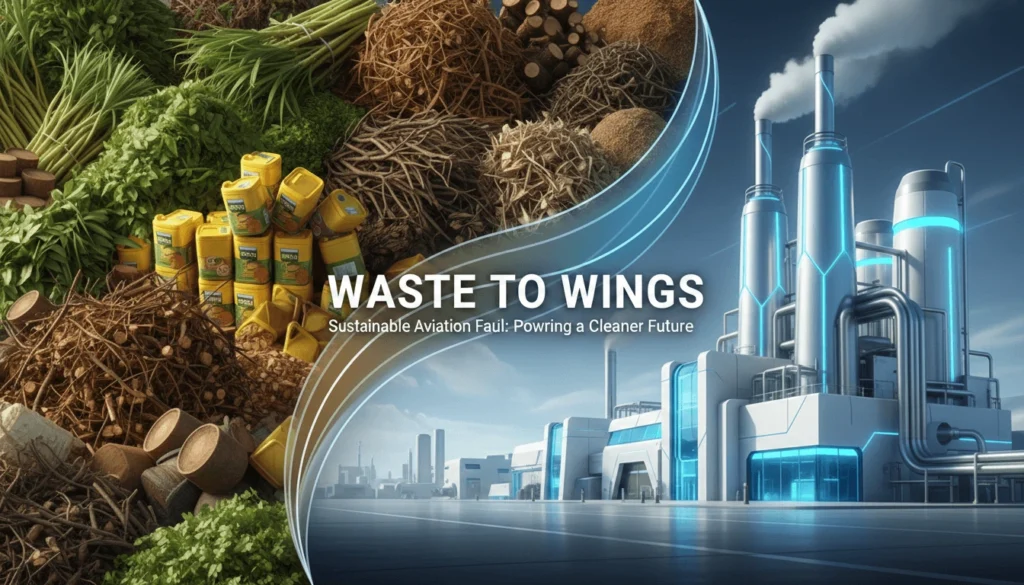
SAF can be produced from a wide range of sources: used cooking oils, agricultural waste, municipal solid waste, forestry residues, and even synthetic processes that combine captured CO₂ with renewable electricity (known as Power-to-Liquid, or e-SAF). The UK government estimates that SAF achieves an average of over 70% lifecycle greenhouse gas savings compared to fossil kerosene, while the U.S. Department of Energy notes that certain pathways can reach up to 94% reductions.
The International Air Transport Association (IATA) has estimated that SAF could contribute roughly 65% of the emissions reductions needed for aviation to reach net-zero CO₂ by 2050. But there’s a catch: getting there requires a production scale-up that dwarfs anything the industry has managed so far.
The numbers don’t lie and right row, they’re worrying
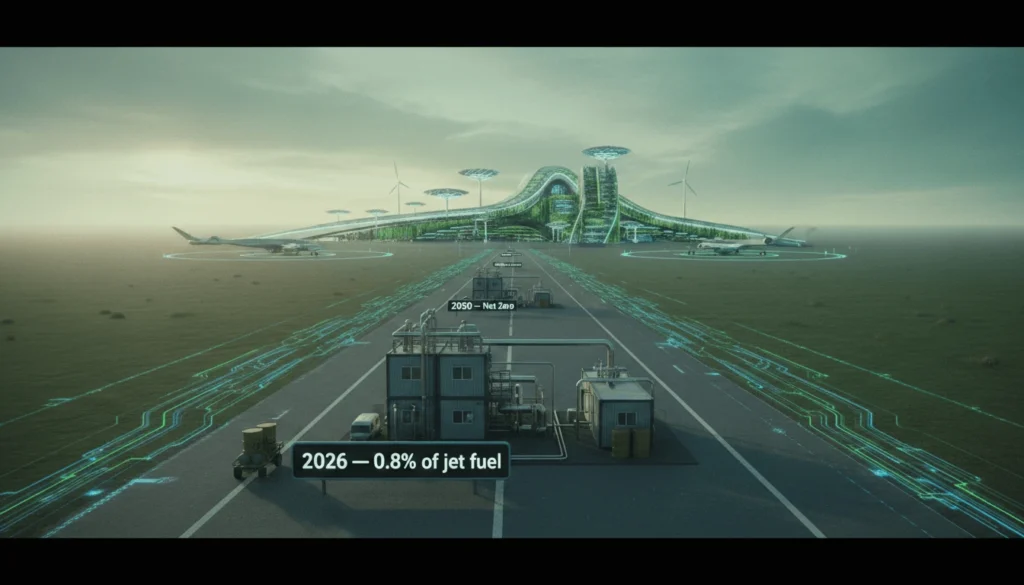
In 2024, global SAF production reached approximately 1 million tonnes. In 2025, that figure doubled to an estimated 1.9 million tonnes — a genuinely impressive rate of growth. But here’s the problem: in 2026, SAF production growth is projected to slow down significantly, reaching only 2.4 million tonnes. SAF production in 2025 represents just 0.6% of total jet fuel consumption, increasing to only 0.8% the following year.
Put those numbers in context: IATA’s own analysis calls for between 3,000 and 6,500 new renewable fuel plants to reach net-zero by 2050. Meanwhile, the U.S. Energy Information Administration projects that SAF will make up about 2% of U.S. jet fuel consumption in 2026. The Biden Administration’s Sustainable Aviation Fuel Grand Challenge set a target of at least 3 billion gallons of annual SAF production by 2030. Current trajectories make that target look extremely ambitious.
The SAF market is valued at over $8.25 billion in 2026, with strong revenue growth projected through 2036 as regulatory mandates and airline net-zero commitments convert aspirational goals into concrete fuel demand. But value and volume are two different things and right now, volume is the bottleneck.
The Policy Landscape: Mandates Are Live, But Cracks Are Showing
Europe Is Leading But Stumbling
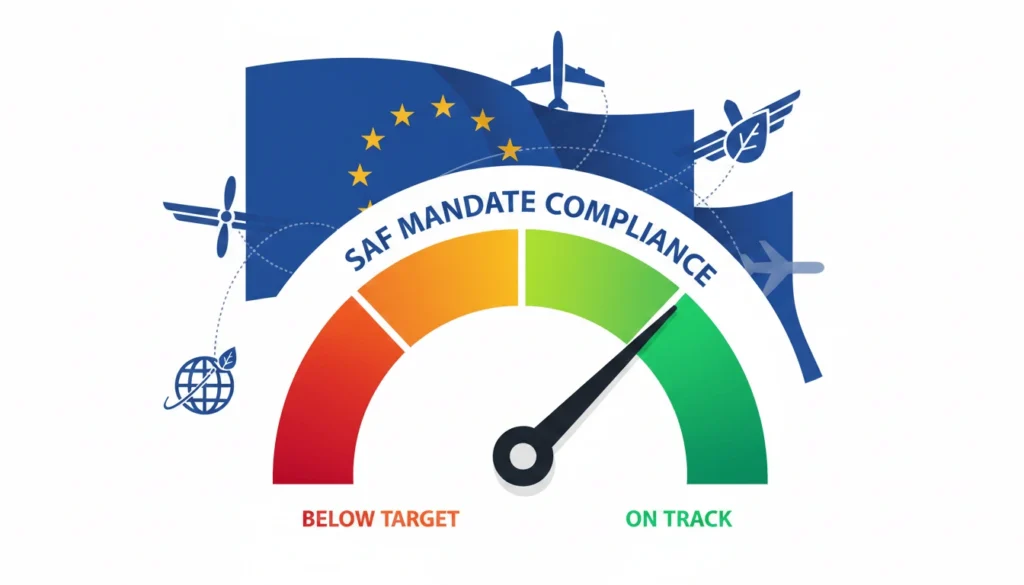
The European Union’s ReFuelEU Aviation regulation came into force in January 2025, setting a minimum SAF supply mandate starting at 2% in 2025 and climbing to 70% by 2050. On paper, this is the most aggressive legislative push for SAF anywhere in the world.
In practice, it’s causing serious friction. In Europe, ReFuelEU Aviation has sharply increased costs amid limited SAF capacity and oligopolistic supply chains. Fuel suppliers have widened their profit margins to such an extent that airlines are paying up to five times more than the price of conventional jet fuel and double the market price of SAF all without guaranteeing supply or consistent documentation.
IATA has been blunt in its assessment. The cumulative impact of poorly designed policy frameworks is that airlines paid a premium of USD $2.9 billion for the limited 1.9 million tonnes of SAF available in 2025, of which $1.4 billion reflects the standard SAF price premium over conventional fuel. The remaining $1.5 billion was incurred as compliance fees costs passed on to airlines to shield fuel suppliers from penalties for not meeting mandated SAF production targets.
The verdict from IATA’s Chief Economist Marie Owens Thomsen was stark: “Europe’s fragmented policies distort markets, slow investment, and undermine efforts to scale SAF production.”
The UK: Mandating Its Way Forward
The United Kingdom introduced its own SAF mandate requiring 3.6% SAF blending in 2026, with a target of 10% by 2030. While the mandate has triggered price spikes a recurring theme across mandated markets some airports are choosing to exceed it rather than merely comply.
Heathrow Airport is increasing its SAF incentive scheme in 2026, setting a target of 5.6% SAF uplift, 2% above the UK mandate, with over £80 million available to airlines to help bridge the cost gap between traditional kerosene and SAF. If achieved, the airport estimates emissions could fall by around 600,000 tonnes in 2026 alone, equivalent to roughly 950,000 economy class round-trip passengers on the London Heathrow to New York JFK route.
Heathrow’s Director of Sustainability Matt Gorman put it plainly: “Sustainable Aviation Fuel is not a hypothetical concept for the future it’s already producing real impact in 2026.”
The United States: A Policy Tug-of-War
The U.S. picture in 2026 is more complicated. The Inflation Reduction Act (IRA) of 2022 introduced meaningful SAF tax incentives and grants that accelerated investment. But the political environment has shifted. At least one bill introduced in the 119th Congress, the Restoring Fuel Market Freedom Act, would repeal SAF-related credits from the IRA. Policy uncertainty is creating hesitation among producers and investors at precisely the moment when commitment is needed most.
CORSIA: The Global Safety Net
The International Civil Aviation Organization’s CORSIA (Carbon Offsetting and Reduction Scheme for International Aviation) framework provides a global baseline, requiring carbon-neutral growth from international aviation relative to 2019 levels through 2035. SAF is one of the primary compliance tools under CORSIA, giving airlines a structural incentive to procure it beyond what national mandates require. But CORSIA alone is unlikely to drive the volumes needed without complementary national policies.
The Cost Problem: SAF Is Still Expensive, Dangerously So
The single biggest barrier to SAF at scale is price. SAF pricing is expected to remain well above conventional jet fuel through 2026, with SAF prices exceeding fossil-based jet fuel by a factor of two, and by up to five times in mandated markets.
For airlines already operating on thin margins in a volatile macroeconomic environment, absorbing a two-to-five times fuel cost premium is not a trivial ask. Airlines are increasingly viewing SAF as a compliance and risk-management cost rather than just a fuel expense, and long-term offtake contracts are being structured to share downside risk between producers and buyers.
The cost problem becomes even more acute when looking ahead to e-SAF (electrofuel SAF, produced from renewable electricity and captured carbon). e-SAF already faces a much higher cost base, potentially up to 12 times that of conventional jet fuel. Without strong production incentives, supply will fall short of targets, and compliance costs could escalate to EUR 29 billion by 2032 if targets aren’t met.
The only way costs come down is through scale. And scale requires investment. And investment requires policy certainty. Which circles back to the core challenge of 2026: the system only works if all the pieces move together.
Why 2026 Is the Inflection Point
So why is 2026 specifically the make-or-break year? Several factors converge:
Final Investment Decisions Are Being Made Now. Large-scale SAF production facilities take years to build and require billions in capital. The investment decisions being made in 2025 and 2026 will determine production capacity in 2028, 2029, and 2030, the years when airline commitments and regulatory targets get significantly more demanding. Policy uncertainty is influencing project timing, with developers delaying final investment decisions until clearer guidance emerges on post-2025 support structures. Every month of delay compounds the gap.
Mandates Are Now Legally Enforceable. The EU’s ReFuelEU regulation and the UK’s SAF mandate are no longer aspirational targets, they are live legal obligations with compliance costs and penalties. How airlines, fuel suppliers, and regulators navigate 2026 compliance will set precedents for how the system functions going forward. A dysfunctional 2026 could undermine confidence in the mandate-driven model globally.
The Production Growth Rate Is Slowing. The doubling of output from 2024 to 2025 was encouraging. But projections show the growth rate decelerating sharply in 2026. If that slowdown becomes a trend, the gap between current output and the 2030 targets becomes mathematically unbridgeable. IATA has already said publicly that a 10% SAF blend by 2030 is “impossible to achieve” with current supply trajectories.
Supply Chains Are Under Stress. Feedstock availability is tightening, and the pricing landscape is evolving in ways that favor caution over ambition from producers. Used cooking oils, the most widely used SAF feedstock today, are increasingly contested by road transport biodiesel and other sectors. Scaling into next-generation feedstocks requires technological maturation and infrastructure that is still years away from readiness.
Political Tailwinds Are Weakening in Key Markets. The political environment in the United States has grown less favorable to clean energy incentives broadly, and SAF is not immune. If U.S. policy support erodes significantly, it will reduce global production capacity, affect international pricing, and send a damaging signal to investors elsewhere.
The Bright Spots: Reasons for Cautious Optimism
Despite the challenges, 2026 is not a story of inevitable failure. There are genuine reasons for cautious optimism.
Corporate Commitments Are Deepening. Major airlines have signed multi-year SAF offtake agreements, not because SAF is cost-competitive today, but because access to supply is becoming a strategic necessity. Demand growth is increasingly voluntary but irreversible once airlines commit publicly, backtracking risks serious reputational damage.
New Capacity Is Coming Online. Projects like SkyNRG’s 100,000-tonne SAF facility in the Netherlands, which recently reached financial close, and a €350 million publicly funded German e-SAF project through the Concrete Chemicals consortium signal that the investment pipeline, while slower than needed, is real and growing.
Airports Are Taking the Lead. Heathrow’s £80 million incentive scheme is one example of airports actively bridging the cost gap rather than waiting for policy to do it. As airports compete for sustainability credentials and airline partnerships, financial support structures are becoming part of the airport value proposition.
Technology Pathways Are Maturing. There are currently 11 ASTM-approved SAF production pathways, and the pipeline of new certification approvals is growing. Diversification of feedstocks and production methods reduces systemic risk and opens new regional supply opportunities, particularly in markets with abundant agricultural waste or renewable electricity.
The Market Is Worth Fighting For. The SAF market is projected to surpass $8.25 billion in 2026 and is expected to show strong revenue growth through 2036, a powerful incentive for private sector actors to solve the production puzzle.
What Needs to Happen to Avoid a “Break” Scenario
For 2026 to be a “make” year rather than a “break” year, three things need to go right:
1. Policy Must Shift From Mandates to Incentives — or Mandate Smarter. IATA’s position is clear: mandates without corresponding production incentives simply redistribute costs rather than create supply. Policymakers in the EU, UK, and U.S. need to pair compliance requirements with robust, technology-neutral incentive structures, subsidies, tax credits, contracts-for-difference, that de-risk long-term investment decisions for producers.
2. Investment Decisions Cannot Wait. The facilities being funded or not funded in 2026 will define SAF supply capacity in the early 2030s. Governments, multilateral development banks, and private investors need to move from interest to commitment. Green bonds, blended finance structures, and public-private partnerships are all tools that can accelerate this.
3. The Supply Chain Must Diversify. Over-reliance on a narrow range of feedstocks creates price volatility and sustainability risks. Scaling up agricultural residue pathways, municipal waste conversion, and eventually power-to-liquid technologies requires coordinated investment across the entire value chain not just at the refinery gate.
The Bottom Line
Aviation is the hardest sector to decarbonize. Unlike road transport, there is no battery technology on the horizon capable of powering a 400-seat aircraft across the Atlantic. SAF is not a perfect solution it’s still carbon-emitting, still expensive, and still dependent on sustainable feedstocks at scale. But it is the most viable bridge technology available, and the most credible pathway to meaningful near-term emissions reductions in aviation.
The decisions made in 2026, by regulators, investors, airlines, airports, and fuel producers, will determine whether SAF becomes a genuine climate solution or an expensive footnote in aviation history. The mandates are in place. The technology exists. The market is real. What’s missing is the political will and coordinated investment to close the gap between ambition and output.
2026 is the year the aviation industry finds out whether it has what it takes to make that leap. The passengers, and the planet, are watching.