

Brent Crude oil price at $94: What the EIA’s Emergency March Forecast Means??
Something dramatic just happened in the oil market. And you are already paying for it.
On March 9, 2026, Brent crude oil price settled at $94 per barrel, the highest price since September 2023 and a staggering 50% surge from where the year started. Twenty-four hours later, on March 10, the U.S. Energy Information Administration released its monthly Short-Term Energy Outlook and the numbers are striking. The EIA did not tinker around the edges of its forecast. It overhauled it entirely.
Just one month ago, the EIA predicted Brent crude would average $58 per barrel in 2026. Today, it is forecasting $79 per barrel for the full year, a $21 per barrel upward revision in a single month. That is one of the largest single-month forecast revisions the agency has ever published. The cause is simple and dramatic: the effective closure of the Strait of Hormuz following U.S.-Israeli military action against Iran has removed a significant chunk of global oil supply from the market and nobody knows for how long.
This article breaks down exactly what the EIA said this morning, what it means for gas prices this spring, and what you should realistically expect at the pump through the summer and beyond.
1. What the EIA’s March 10 STEO Actually Says
The EIA publishes its Short-Term Energy Outlook on the second Monday of every month. It is the most authoritative, data-driven oil and gas price forecast published by any government agency in the world. When the EIA revises its outlook this sharply, in a single month, the market pays attention and so should you.
The Brent Price Forecast: A Complete Reversal
The headline number from today’s report is stark. The EIA now forecasts Brent crude will remain above $95 per barrel for the next two months, meaning March and April 2026. That is the near-term outlook. From there, the agency expects prices to fall below $80 per barrel in the third quarter of 2026, and to around $70 per barrel by the end of the year. For full-year 2026, the EIA now forecasts a Brent average of $79 per barrel.
Put that in context. Just four weeks ago, in its February STEO, the EIA forecast a full-year 2026 Brent average of just $58 per barrel. The Strait of Hormuz crisis has added $21 per barrel to the agency’s full-year forecast in a single revision cycle. For 2027, the EIA raised its forecast from $53 per barrel to $64 per barrel, another dramatic upward revision.
The Key Assumption Behind Every Number
Here is the critical caveat buried inside the EIA report. The agency states clearly: this price forecast is highly dependent on its modeled assumptions about both the duration of conflict in the Middle East and the resulting outages in oil production.
The EIA assumes the effective closure of the Strait of Hormuz will cause Middle East oil production to fall further in the coming weeks. It then assumes that shut-in production will gradually ease as transit through the Strait resumes. That gradual recovery assumption is what drives prices below $80 in Q3 and toward $70 by year-end.
If that assumption is wrong, if the conflict drags on longer, or if critical oil infrastructure sustains permanent damage, every number in the forecast changes. The EIA is not predicting a resolution. It is modeling one. That distinction matters enormously.
US Production Gets a Boost
One silver lining in the report: higher crude oil prices are expected to stimulate more U.S. oil production. The EIA now forecasts U.S. crude oil output will average 13.6 million barrels per day in 2026 and rise further to 13.8 million barrels per day in 2027. The 2027 figure is 0.5 million barrels per day higher than last month’s forecast. American shale producers respond to price signals quickly. Higher prices mean more drilling. More drilling means more supply. That added U.S. production acts as a partial offset to the Middle Eastern supply disruption but only partial.
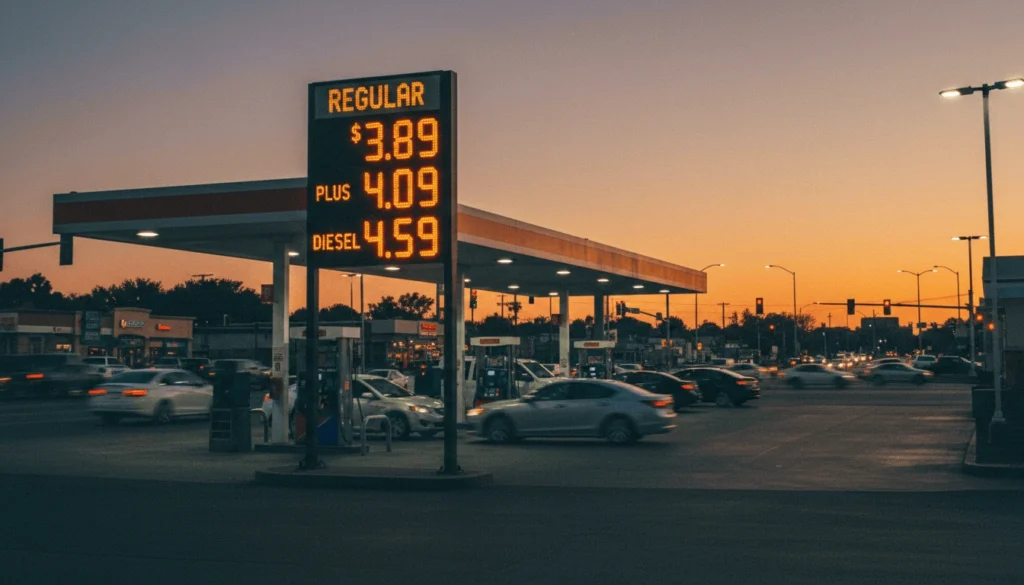
2. What $94 Oil Means for Gas Prices Right Now
The crude price surge is already hitting American drivers. Here is how the transmission mechanism works and how much pain is already priced in.
The Pump Price Math
Crude oil accounts for roughly 54% of what you pay at the gas pump. That means every $10 per barrel increase in crude translates to approximately 23 to 24 cents per gallon at the retail level. Brent crude has risen roughly $30 per barrel since the start of 2026. The mathematical pass-through from that move alone is approximately 70 cents per gallon.
In practice, the actual pump price increase is smaller and slower than that calculation suggests. Refiners carry inventory purchased at lower prices. Retail pricing adjusts with a two-to-four week lag. The U.S. government holds strategic petroleum reserves that can be released to buffer supply shocks. But over time, the math catches up.
The Spring Seasonal Pressure Adds On Top
The crude oil spike is landing at the worst possible moment on the seasonal calendar. Spring is already when gas prices rise before a single geopolitical event occurs.
Every year, refineries switch from producing cheaper winter-blend gasoline to more expensive summer-blend gasoline. The summer formula is required by federal clean air regulations and costs significantly more to produce approximately 8 to 10 cents per gallon more. That switchover happens between late February and June 1, depending on region. It was already pushing prices higher before Brent hit $94.
Before this crisis, GasBuddy had projected a seasonal gasoline price peak of $3.12 per gallon in May 2026. The EIA’s February forecast had projected Q2 2026 at $3.04 per gallon. Both of those forecasts were built on a $58 per barrel Brent assumption. With Brent now expected to stay above $95 through April, those projections are obsolete.
What the National Average Could Hit This Spring
The honest answer is that nobody knows exactly, because the outcome depends on how fast the Strait of Hormuz situation resolves. But the directional math is clear. A sustained $30 per barrel crude increase above the pre-crisis baseline would, if fully passed through, add 70 cents per gallon to retail prices. Even with a partial pass-through of 50%, that is 35 cents on top of a pre-crisis forecast of $3.04 to $3.12. That puts the potential spring peak in the $3.40 to $3.50 range nationally and higher in already-expensive states like California, where pump prices were already averaging $4.50 before the crisis.
3. Diesel: The Fuel Getting Hit Hardest
While gasoline gets the media attention, diesel is absorbing the sharpest shock. Diesel serves the backbone of the economy, every truck, every freight train and every construction machine. Its price affects the cost of everything you buy.
Why Diesel Reacts Faster and Harder Than Gasoline
Diesel is a middle distillate, the same refinery fraction that produces jet fuel and heating oil. It is more directly linked to Strait of Hormuz supply than gasoline, because Middle Eastern refineries produce disproportionately more middle distillates. When the strait closes, the global middle distillate supply shrinks faster than the gasoline supply.
Diesel crack spreads in Europe surged to their highest level since August 2023 in the days following the strikes. The U.S. diesel crack spread — the refiner’s margin for producing diesel versus crude spiked to approximately $70 per barrel. That margin eventually passes through to truckers, farmers, and fleet operators in the form of higher pump prices.
What Diesel Was Forecast to Cost Before the Crisis
Before the Middle East escalation, GasBuddy had forecast U.S. on-highway diesel at $3.55 per gallon for full-year 2026, down from $3.62 in 2025. The EIA’s February STEO had projected diesel averaging less than $3.50 per gallon. Both forecasts assumed $58 per barrel Brent and normalizing refinery conditions.
Those forecasts are now outdated. With crude elevated and middle distillate crack spreads surging, diesel at the national average level is likely to push well above $3.75 per gallon in the near term, potentially approaching $4.00 in regions with less refining capacity or more supply chain exposure to Gulf imports. For trucking companies running on thin margins, this is not an abstraction. It is a direct cost shock that ripples through freight rates and ultimately through the price of every physical good transported by road.
The Industrial and Agricultural Ripple Effect
Diesel price spikes are an inflation multiplier. They raise the cost of transporting food from farm to grocery store and also the cost of construction materials. They raise the cost of agricultural operations, diesel powers most of the tractors, irrigation pumps, and harvesting equipment that feeds the country.
The EIA has noted that lower crude oil prices had been expected to contribute to significantly lower prices for gasoline and on-highway diesel in 2026. That expectation was the basis for optimistic inflation forecasts entering this year. The March crude oil shock has materially changed that inflation outlook and it will show up in CPI data within the next 60 days.

4. Jet Fuel and Spring Travel: The Aviation Cost Shock
Spring break travel season is in full swing. Airlines had been counting on lower jet fuel costs in 2026. That bet has gone badly wrong.
The Jet Fuel Crisis Inside the Crisis
Jet fuel was already facing structural supply pressures in early 2026 due to tightening refinery capacity and strong post-COVID travel demand. Then the Strait of Hormuz shutdown hit the one region that supplies a disproportionate share of global jet fuel to Asian and European markets.
The jet fuel crack spread, the margin between crude oil and refined jet fuel, surged to nearly $100 per barrel following the crisis. Under normal conditions, that spread is below $20. A $100 spread means refiners are capturing extraordinary margins on every gallon of jet fuel they produce. It also means airlines are paying extraordinary prices.
What This Means for Spring and Summer Airfares
Airlines absorb fuel shocks with a lag. Tickets already sold for March and April spring break travel were priced months ago before crude hit $94. Airlines are absorbing that loss on existing bookings. But summer inventory is still being priced and sold right now. Revenue management teams at every major carrier are recalculating load factors and pricing strategies based on a fuel cost environment that changed dramatically in the last two weeks.
The consumer impact arrives in two waves. First, airlines that entered 2026 with heavy fuel hedging programs are partially insulated but no hedge is unlimited, and above $95 per barrel, most hedge books have limited protection. Second, summer 2026 airfares will reflect the higher cost environment directly, through yield management and fuel surcharges. Passengers booking flights today for July and August should expect prices that do not reflect the sub-$70 crude world that existed just two months ago.
5. The EIA’s Forward Forecast: What to Expect Month by Month
The March STEO gives a clear directional roadmap with important caveats at every step.
March and April 2026: Above $95
The EIA expects Brent to stay above $95 per barrel for the next two months. This is the worst period for fuel prices. Crude is elevated, the summer blend switchover is underway, and spring driving demand is building. Gas prices will likely peak during this window. Diesel and jet fuel crack spreads will remain wide. This is when consumers and businesses feel the most acute pain.
Q3 2026: The Expected Relief
If the EIA’s conflict resolution assumptions prove correct, Brent falls below $80 per barrel in Q3 2026. That would be a meaningful decline from the current $94, roughly a $15 drop. At that crude level, gasoline prices would pull back from spring peaks. The original Q2 forecast of $3.04 per gallon would likely resurface as a reasonable Q3 estimate, possibly falling further toward the original Q4 forecast of $2.76 per gallon if the crisis resolution happens faster than modeled.
The critical word in that sentence is “if.” The EIA is modeling a scenario, not guaranteeing an outcome. Iran’s willingness to resume negotiations, signals of which emerged Wednesday, is a positive indicator. But military conflicts rarely resolve on the schedule that financial models assume.
Year-End 2026 and Into 2027
The EIA expects Brent to close 2026 around $70 per barrel and average $64 per barrel in 2027. Both numbers are significantly higher than pre-crisis forecasts of $58 and $53 respectively. The crisis has structurally shifted the expected price path for the next 18 months, even if it resolves relatively quickly. The reason is simple: the conflict has demonstrated that Hormuz risk is real and present. Markets permanently price in a higher risk premium after a near-miss and this was more than a near-miss.
The Bottom Line: A Spring of High Prices, a Summer of Relief If Everything Goes Right
The EIA’s March 10, 2026 forecast tells one clear story. Brent crude at $94 means elevated fuel prices across the board for the next two months. Gas prices are heading higher than pre-crisis forecasts expected. Diesel will remain significantly elevated and could approach $4.00 per gallon in affected regions. Jet fuel costs will push airfares higher through summer booking season.
The relief scenario, prices falling below $80 in Q3 and toward $70 by year-end, depends entirely on the Strait of Hormuz reopening and Middle Eastern production recovering on the EIA’s assumed timeline. Any delay to that timeline means higher prices for longer.
What you can do right now: fill up before prices peak further if you drive regularly. Budget more for transportation costs through May. Watch the Strait of Hormuz news closely — it is, for now, the single most important variable in your energy bill.
Track live oil prices and stay updated on market-moving energy news at fueloilcompany.com
Source: U.S. Energy Information Administration, Short-Term Energy Outlook, March 10, 2026.